Standard Compatibility
To ensure sustainable e-assessment, the ONYX Testsuite uses established and open standards. The data model of the ONYX Testsuite is based entirely on the 1EdTech Question & Test Interoperability (QTI) specification, formerly IMS QTI. The description of the metadata is done via the open standard IEEE Learning Object Metadata LOM.
Any content you create and manage with the ONYX test suite, including generated exam results, is available in a standardised and interoperable format. As a result, it can be used and exchanged over the long term and can be imported and exported between different e-assessment and learning systems.
As an active member of the 1EdTech Consortium, BPS Bildungsportal Sachsen GmbH contributes its many years of experience with the QTI specification and is continuously involved in the international 1EdTech community. The ONYX test suite is independently audited annually and certified by 1EdTech for QTI standard compliance. Thus, ONYX serves as a reference implementation and is officially listed and recommended as a standardised e-assessment tool, see Certification
Due to its sustainable approach, including the consistent use of open standards and the provision of flexible, integrable assessment modules, the ONYX Testsuite was already honoured with the Learning Impact Award several times.
1EdTech's Question & Test Interoperability (QTI)
The concept behind the ONYX test suite is based on the internationally recognised 1EdTech Question & Test Interoperability (QTI) specification, formerly IMS QTI. Several key functions of the test suite are directly based on this standard.
Using QTI allows for platform-independent content exchange and offers several other advantages, such as a strict separation of content and layout, as well as XML-based display of all test and task content. It ensures independence from the final format and allows for easy adjustments at a later stage. QTI specifications define the exchange of test content in the form of a content package that includes all relevant test data, LOM metadata, and embedded media. Formulas are displayed within the test data in MathML-notation.
In addition to the test and task content itself, the results data is also displayed in accordance with the QTI Results Reporting Model. Generated report files contain all evaluation information, including learner responses, time stamps, and achieved scores. For manual evaluations, the results file is expanded accordingly so that the entire evaluation process remains traceable. Furthermore, the results can be exported as a CSV file.
1EdTech QTI – Versionen There are currently three main versions of the QTI specification:
|  |
QTI version 2.x is particularly well established and widely used, and is supported by numerous learning and examination platforms. The latest version is QTI 2.2. The previous version QTI 2.1, was officially replaced by 1EdTech on 31 December 2024.
The ONYX Test Suite is 1EdTech QTI 2.2 certified and offers full support for QTI 2.1. The ONYX Editor also enables the import and export of test data, including the import of QTI v1.2. Since QTI 1.2 has been implemented differently by various system manufacturers, import and export in this version are system-specific. The QTI 1.2 import has been tested for Blackboard, WebCT, and OLAT, among others.
To use the test data created in paper-based test scenarios, ONYX Editor offers a PDF export function. Beyond that, various conversions for proprietary formats have been successfully implemented.
IEEE LOM
ONYX fully supports the open standard IEEE Learning Object Metadata (LOM) for the structured description of task and test content.
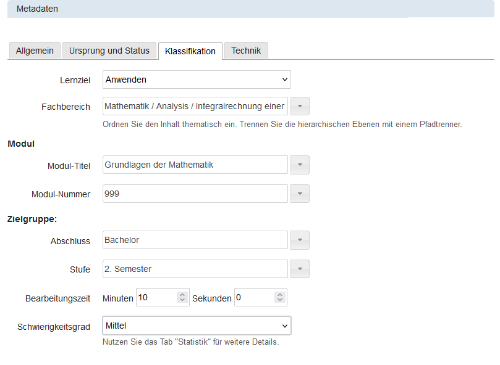
Metadata is stored in XML format in the IMS manifest of the test data, and the layout complies with 1EdTech QTI standard specifications. General metadata, such as title, description and keywords, is maintained manually by the author in the ONYX Editor. Additional information is also automatically recorded and stored in the metadata in accordance with standards. This includes life cycle data such as technical creator, editor and processing times. Information about the resource type, used software and its versions is also automatically documented. A unique reference link in the manifest also ensures clear and traceable allocation of the respective resource.
The metadata that can be captured and edited in the editor can be defined via an installation-specific metadata configuration. This allows each system to be individually adapted to the requirements of the respective institution. Onyx recommends using a predefined metadata set based on the central entries of the IEEE LOM for learning and assessment content.
Standard metadata profile